



















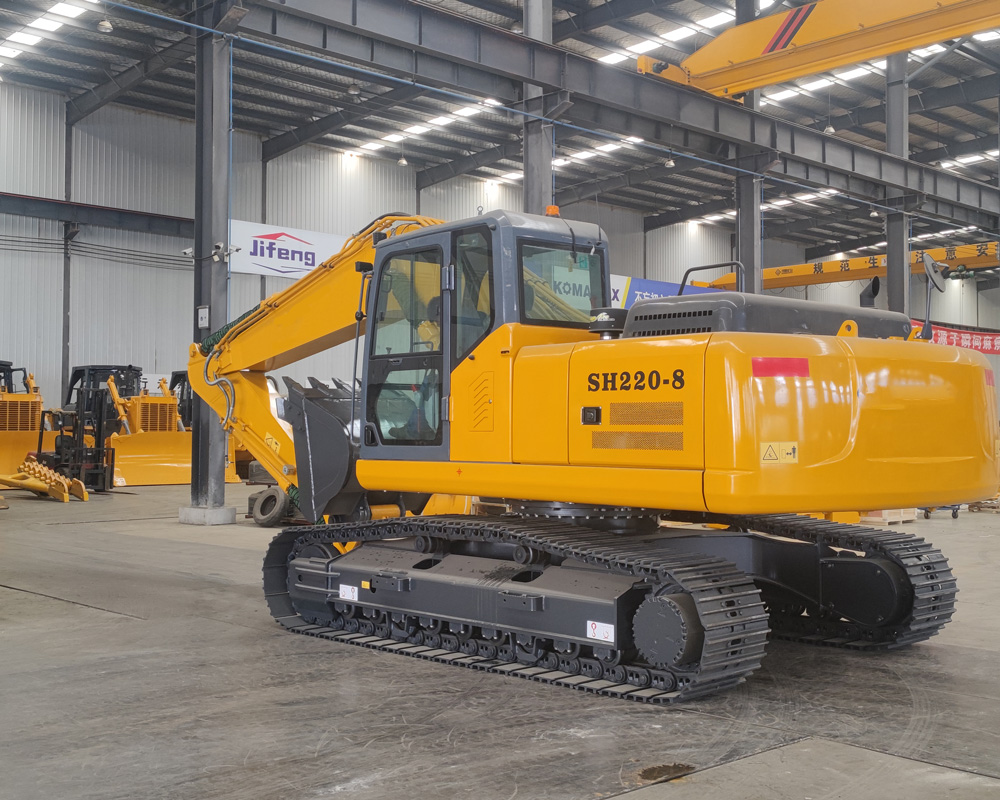
When you receive a set of medium excavator technical specifications, the common situation is dozens of parameters in different units, with no single answer to which to read first. The reader goal here is specific: when screening equipment for earthwork excavation, truck loading support, or general infrastructure construction, you should be able to quickly judge from the spec table whether the machine matches the working conditions, rather than reading from start to finish and then comparing from impression. Below, using the specification data of a 21.2-ton crawler excavator as an example, we explain the reading order, the relationships between fields, and which conclusions cannot be drawn from the spec table alone.
First clarify what questions the specifications need to answer
The spec table itself does not distinguish primary from secondary items; the reading order should be determined by the work objective. First group the requirements into three categories, then map them to fields:
- Working range: whether excavation depth, dumping height, and swing radius cover the site layout, corresponding to fields such as maximum digging depth, maximum digging height, maximum dumping height, and maximum digging radius.
- Digging and truck loading: material density, bucket matching, and loading cycle, corresponding to fields such as bucket capacity, bucket digging force, stick digging force, and swing speed.
- Site access and continuous operation: transport dimensions, gradeability, travel speed, ground pressure, and fuel tank capacity, corresponding to overall dimensions, traction force, gradeability, track shoe width, and fuel tank volume.
The three types of requirements often exist at the same time, but with different priorities. For deep foundation pits or high dumping operations, working range fields should come first; for yards focused on truck loading, the match between digging force and bucket capacity deserves earlier attention; for access via mountain roads or temporary tracks, first check whether transport dimensions and gradeability conditions are met. Different orders may lead to different judgments, so the first step in reading specifications is not to flip through the parameters, but to clearly state the main tasks this machine must complete.
Which site arrangements the working range fields correspond to
Working range is a group of data that is relatively easy to misread. Taking this model's specifications as an example, the maximum digging depth is 6490 mm, maximum digging height 10950 mm, maximum dumping height 7190 mm, and maximum digging radius 9860 mm, with a maximum vertical digging depth of 5915 mm and a maximum digging radius at ground level of 9675 mm. These values describe limit positions under a specific boom length and posture, and are not equal to working dimensions that can be stably achieved under any condition.

When reading, compare them item by item with site conditions: whether the design depth of the foundation pit or pipe trench falls within the maximum digging depth with margin; whether the dumping point height is below the maximum dumping height; whether there are obstacles or existing facilities within the swing working radius. The specifications also give a boom length of 2925 mm and the stick configuration, indicating that working range is related to the boom and arm combination, and values after changing the work equipment need to be reconfirmed for the corresponding configuration. Judging whether the machine can cover the entire work face only by the maximum digging radius can easily overlook limitations from positioning and swing angle.
Correspondence between digging force, bucket capacity, and loading cycle
This model's specifications list a bucket capacity of 1.06 m³, bucket width of 1254 mm, 5 bucket teeth, maximum bucket digging force of 146 kN, stick digging force of 140 kN, and swing speed of 12.4 rpm. These items are often viewed together, but they do not answer the same question.
- Bucket capacity and bucket width determine the single-load volume and excavation face width, and also affect matching with the transport vehicle body.
- Bucket digging force and stick digging force reflect cutting capability at different action stages; when the material changes from loose soil to compacted soil or soil containing stones, the actual performance corresponding to the same value will change.
- Swing speed relates to cycle time, but loading efficiency also depends on vehicle waiting, site layout, and operator coordination; swing speed alone cannot be used to estimate shift output.
The specifications do not provide digging capability test data by material category, nor loading efficiency records. Therefore, this part can only serve as a basis for configuration matching and cannot be used to promise actual output in a certain type of ground. For conditions with hard soil, weathered rock, or large stones, the material conditions should be listed separately, and the supplier should be asked to confirm whether the work equipment and bucket teeth configuration are suitable.
Power and hydraulic fields should be read as a group
The engine and hydraulic system are the two most closely related groups of fields in medium excavator specifications. This model uses a 6-cylinder turbocharged engine with a displacement of 5.9 L, rated power of 133 kW/2000 rpm, and maximum torque of 708 N·m/1500 rpm; the hydraulic system uses variable dual piston pumps with a maximum flow of 2×224 L/min, travel system pressure of 34.3 MPa, swing system pressure of 25.5 MPa, and pilot control pressure of 3.9 MPa.

The significance of reading them as a group is that power and torque indicate the power reserve, while pump flow and system pressure indicate the basic conditions for action output; the two should be understood under the same working mode. The specifications mention that the machine offers three adjustable working modes, but do not explain the specific power distribution and flow changes in each mode; this is content that needs to be confirmed with the supplier. In addition, the "pilot control pressure" in the parameters is unrelated to the power form, and it cannot be inferred from this that the machine is electric or hybrid; electronic control, hydraulic pilot control, and pure electric drive are different concepts, and such an association should not be made when the specifications do not mention an electric configuration.
Undercarriage and site access conditions
Before crawler equipment enters a site, transport dimensions and ground bearing capacity are unavoidable constraints. This model has an overall length of 9625 mm, overall width of 2800 mm, overall height to the top of the cab of 3055 mm, transport ground contact length of 4915 mm, track shoe width of 600 mm, ground pressure of 49.8 kPa, and operating weight of 21200 kg. For the travel system, the maximum travel speed is 5.1 km/h, traction force is 214 kN, gradeability is 70% (35°), and the number of track shoes is 2×46.
These fields are not used to compare sizes, but to check item by item against the transport route and work face: whether the flatbed trailer's loading length and width cover the overall dimensions; whether the bearing capacity and slope of the access road and work face are within the capabilities marked in the specifications; when working on soft ground or backfilled areas, whether the 600 mm track shoes and 49.8 kPa ground pressure suit the current conditions. Gradeability values are usually calibrated under specific conditions; the actually usable slope is also affected by road adhesion, load, and operating method, and should not be directly applied to muddy or loose temporary roads.
Maintenance accessibility and parts not covered by the specifications
This model's specifications mention that filters and maintenance points are designed for ground-level servicing and that it is equipped with an auto-idle function; fuel tank volume is 330 L, hydraulic tank and system are 250 L and 400 L respectively, coolant is 28 L, and engine oil is 22 L. This information can be used to assess the convenience of daily inspections and arrangements for refueling and fluid replenishment, but the specifications do not give maintenance intervals, filter replacement intervals, or specific service steps. For maintenance planning, the accompanying manual and the maintenance information provided by the supplier should be used; the spec table itself does not constitute a maintenance basis.
Other items that also need separate confirmation include: changes in working range under different stick and boom combinations, specific settings of each working mode, attachment configurations suitable for specific ground, disassembly and assembly requirements during transport, and on-site power supply or filling conditions. The specifications give data for the machine in its calibrated state; specific projects still need to be checked against materials, site, and shift arrangements.
Checklist organized by requirement
| Work question | Fields to read first | Still to confirm |
|---|---|---|
| Whether the foundation pit or trench can be excavated to the required position | Maximum digging depth, maximum vertical digging depth, maximum digging radius | Boom and arm combination, positioning, and slope conditions |
| Whether high dumping or truck loading is smooth | Maximum dumping height, maximum digging height, swing speed | Transport vehicle height, site layout |
| Whether the material matches | Bucket capacity, bucket width, bucket and stick digging force | Material category, attachment and bucket teeth configuration |
| Whether site access is smooth | Overall dimensions, operating weight, travel speed, gradeability | Transport vehicle, road bearing capacity and slope |
| Whether operation on soft ground is feasible | Track shoe width, ground pressure | Current foundation conditions and seasonal effects |
Returning to the initial question: which fields should be read first in medium excavator technical specifications? The answer depends on the main tasks this machine must complete. The four groups of fields—working range, digging force and bucket capacity, power and hydraulics, and undercarriage—correspond respectively to work coverage, material matching, action output, and site access conditions, and none of them alone can support a selection conclusion. The specifications provide a starting point for judgment; materials, site, shifts, and supporting transport conditions still need to be explained item by item during the inquiry stage.
If a specific project requires further configuration verification, prepare information such as material type and density, excavation depth and dumping height, average daily workload and shifts, site bearing capacity and transport route, power form, and work equipment requirements, and confirm item by item with the supplier using this model's product information.