



















Excavation in quarries differs from general earthmoving: the material is mostly a mixture of blasted rock blocks and crushed stone, the loading target is dump trucks, and the working face changes continuously as the bench advances. A common question from buyers is what a medium-to-large crawler excavator can and cannot do in heavy-duty quarry operations. This question is difficult to answer with a single number because "heavy-duty" itself depends on material lump size, loading height, bench layout, and shift arrangements. This article uses verified data for a 21-ton crawler excavator as a sample to explain which capabilities are supported by data and which boundaries require on-site confirmation.
First define the actual constraints of heavy-duty quarry operations
The excavation phase in a quarry typically includes several types of actions: stripping overburden, clearing muckpiles, loading dump trucks, and dressing the working face. Compared with ordinary earthmoving, the material faced by the bucket is more uneven—large rock blocks and fine fragments may coexist in the same muckpile. This imposes requirements not on the level of any single indicator but on the coordination among digging force, hydraulic response, structural wear resistance, and overall machine stability.
At the same time, the quarry working face is often constrained by bench width and haul road. The machine's overall dimensions, tail swing radius, and minimum ground clearance directly affect slewing and loading transitions within limited space. These conditions need to be matched to the actual site during the selection stage, rather than adjusted after the machine arrives.
Whole-machine capabilities that this data can explain
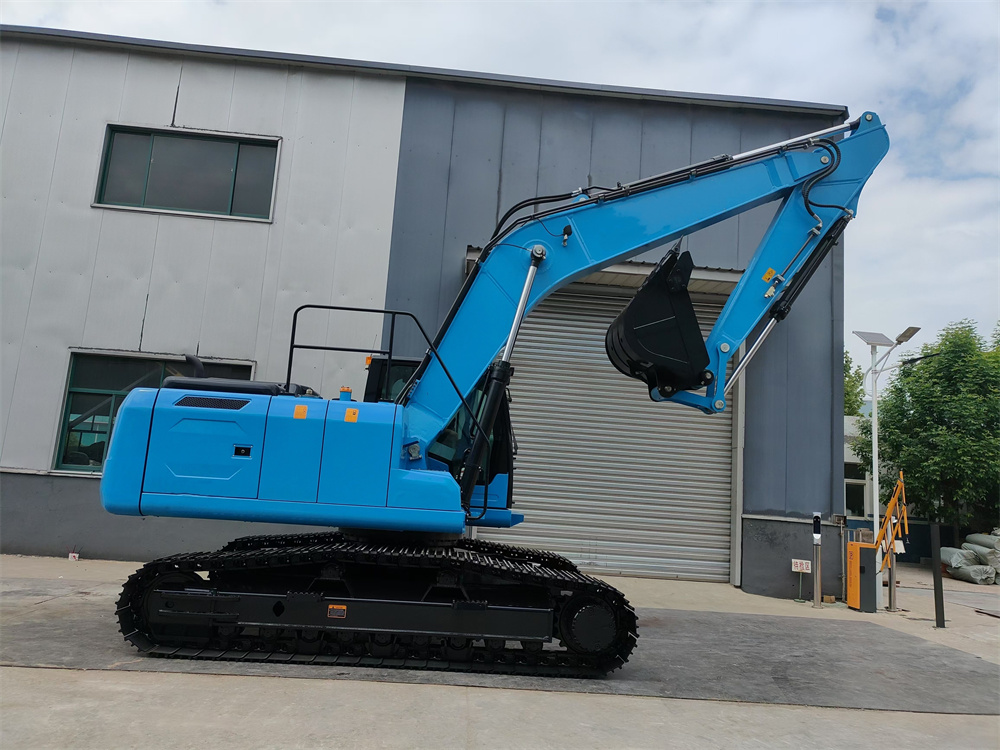
The crawler excavator associated with this article is a 21-ton-class machine equipped with a 1 m³ standard bucket, with an engine rated power of 129 kW (173 HP) at a rated speed of 2200 rpm. The following parameters are directly relevant to judging heavy-duty quarry operations:

- Maximum bucket digging force 140 kN, arm digging force 99 kN, system pressure 32 MPa—used to judge the force level that can be exerted at the bucket end when cutting soil and breaking rock blocks;
- Swing speed 11–13 rpm—affects the rhythm of the swing phase in the loading cycle;
- Maximum digging depth 6480 mm, maximum digging radius 9850 mm, maximum dumping height 6730 mm—used to check the match between working face height and dump truck body height;
- Maximum gradeability 30°, minimum ground clearance 470 mm—used to judge travel conditions on quarry ramps and uneven ground;
- Overall dimensions 9590×2980×3185 mm, tail swing radius 2880 mm—used to check working face width and slewing space.
The data also mention that the main boom is integrally welded and formed with precision boring and shot peening, the arm connection joints are forged, and the bucket uses thickened wear-resistant steel plates. These descriptions correspond to the direction of structural durability under long-term heavy-duty conditions, but the data do not provide quantitative data on wear life or fault intervals, so specific service cycles cannot be inferred from them.
Correspondence between parameters and quarry requirements
| Operational requirement | Corresponding item in the data | Boundary to note |
|---|---|---|
| Breaking and loading rock blocks | Bucket digging force 140 kN, system pressure 32 MPa | Material lump size and hardness are not quantified in the data; it cannot be asserted that any rock type can be handled |
| Loading dump trucks | Maximum dumping height 6730 mm, swing speed 11–13 rpm | Dump truck model and parking position must be checked; the data do not cover specific body heights |
| Bench and ramp travel | Maximum gradeability 30°, minimum ground clearance 470 mm | Actual ramp traction conditions and road surface conditions must be confirmed on site |
| Slewing in restricted working faces | Tail swing radius 2880 mm, overall width 2980 mm | Net working face width and safety distance must be calculated according to site layout |
As can be seen from the table, the parameters can answer "under what geometric and mechanical conditions the machine has operational capability," but cannot answer "how much output can be achieved at a specific quarry." Output also depends on blasting results, haul truck turnaround, operator skill, and shift organization, none of which are provided in the data.
Configurations specified in the data and conditions requiring separate confirmation
The data describe the machine mainly in terms of power, hydraulics, structural strength, cab, and maintenance accessibility. Several items are relevant to heavy-duty quarry operations:

- The engine uses turbocharging technology; the data state it can operate in high-altitude and low-temperature environments, but specific altitude and temperature limits are not given, so corresponding operating condition descriptions should be requested from the supplier;
- The hydraulic system uses dual-pump confluence to increase oil supply flow and response speed for the boom, arm, and bucket;
- Electronic throttle control and auto-idle function; the engine enters idle state after 5 seconds of no operation;
- Maintenance filters are arranged in ground-accessible positions for easy inspection and replacement;
- Enclosed cab with heating and air conditioning and a shock-absorbing seat.
It should be noted that the data do not mention whether the machine is equipped with quarry-specific protective configurations, such as cab protective structures, track shoe types, or bucket tooth specifications. These are common check items in heavy-duty quarry scenarios; the data in this article do not support direct conclusions, and they should be confirmed item by item during inquiry.
Information to be submitted to the supplier before purchase
If the intended use is heavy-duty excavation in a quarry, machine tonnage class and bucket capacity alone are insufficient for an effective inquiry. It is recommended to provide the following conditions during inquiry:
- Material type and lump size range, as well as gradation after blasting;
- Working face bench height, width, and ramp conditions;
- Body height and parking method of the matched dump trucks;
- Daily work shifts and continuous operating duration;
- Environmental conditions such as site altitude and temperature;
- Width limits, weight limits, and turning conditions of the transport access road;
- Whether specific work equipment or protective configurations are required.
These pieces of information determine whether the machine can coordinate with the site, rather than simply comparing parameter levels. Parts not covered by the data should be subject to written confirmation from the supplier and should not be inferred from model or tonnage class.
Summary of applicable boundaries
Based on the verified data, this 21-ton crawler excavator has a 1 m³ bucket, 129 kW power, and 140 kN bucket digging force, with a working range covering 6480 mm digging depth and 6730 mm dumping height; it is a model that can participate in quarry loading and working face dressing. However, whether it is suitable for "heavy-duty quarrying" depends on material breakability, working face layout, and transport coordination, and the data do not provide quarry-specific verification. Therefore, a more reliable judgment approach is to use the above parameters as a screening starting point and treat material, site, and supporting conditions as confirmation items, proceeding to a procurement decision only when both are satisfied.
For continuous heavy-duty scenarios such as quarries, the supplier should also be asked to confirm the warranty scope for structural components, supply of wear parts, and on-site service arrangements. These items are not part of the specification table but directly affect the machine's availability under heavy-duty conditions.