




















In machine selection discussions for earthwork loading, a common simplification appears: divide the volume per truck by bucket capacity, calculate the required number of bucket loads, and use that to determine equipment size. This method is not useless, but it only answers "how much can one bucket hold" and does not answer "how many cycles can be completed per hour, can the site supply trucks continuously, and does the ground allow a full bucket." If output calculation stops at bucket capacity, it is easy to discover only after mobilization that the pace does not match.
Bucket capacity gives bucket counts, not cycle pace
Actual loading output is determined jointly by effective load per bucket, cycle time per pass and effective working time. Bucket capacity is a nominal value; whether each bucket is actually full depends on material looseness, moisture state and digging face height. Cycle time is affected by swing angle, dump height and operator coordination. Estimating shift output from bucket capacity alone assumes all these conditions are ideal.
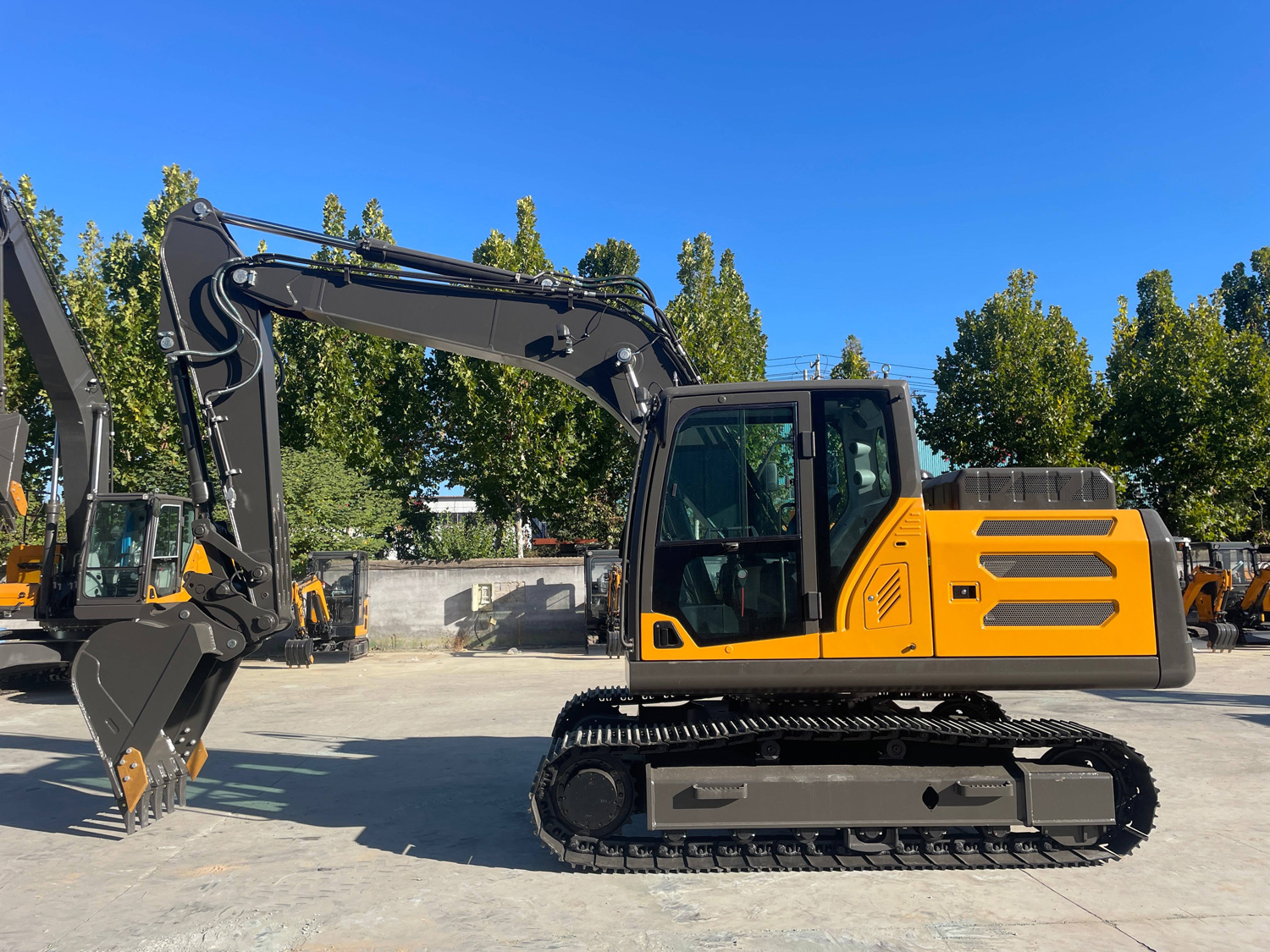
Take a 15-tonne tracked excavator in our product information as an example. Its bucket capacity is 0.6 m³, operating weight is 15,000 kg, and rated power is 110 kW (148 HP). These figures can be used to frame the task scale initially, but cannot be converted directly into loading volume per hour. The same information also gives maximum digging depth of 5,343 mm, maximum dump height of 6,025 mm and maximum digging radius of 8,198 mm. These are more useful for judging work face layout and whether dumping is smooth, not as productivity commitments.

Which verified features relate to loading pace
If the focus of output calculation is cycle efficiency, then structures in the equipment information related to cycling deserve item-by-item comparison. The model information mentions that the main cylinders (boom, arm, bucket) have built-in cushioning structures to reduce impact and vibration during operation. Dual-pump confluence technology increases oil flow to each cylinder, which the information describes as shortening cycle time. These two items are hydraulic and work equipment information, not the same dimension as "how large the bucket is," but both feed into loading pace.
- The swing speed is listed as 0–12 rpm, and the swing control system is described as enhanced to absorb vibration and achieve precise stopping. In conditions with large swing angles and high dump alignment requirements, this affects each cycle more directly than bucket capacity.
- Maximum bucket digging force is 91 kN and maximum arm digging force is 55 kN. The information also states that the bucket cutting edge uses wear-resistant steel and is fitted with reinforced teeth. Digging force and tooth condition affect whether a full bucket can be maintained stably, especially in harder or gravelly material.
- The electronic throttle control system and intelligent auto-idle function are described as managing engine output and reducing speed after 5 seconds without operation. This is power management and may affect fuel consumption and noise, but specific fuel consumption figures cannot be inferred from it.
Three constraints easily missed when sizing by bucket capacity
Material and digging face conditions
The effective load of the same bucket capacity differs markedly in different materials. The information positions this model for earthwork, road construction, municipal engineering and high-altitude site operations, and mentions high-altitude adaptability from turbocharging. But "suitable" is a directional description. Whether a specific yard achieves a full bucket, or whether ripping or loosening is needed, still must be confirmed against actual material; the information does not provide corresponding productivity data.
Haulage coordination and site layout
Loading output is also constrained by the number of dump trucks, entry and exit routes, and dump height. The model has a maximum dump height of 6,025 mm, minimum swing radius of 2,770 mm and tail swing radius of 2,389 mm. These dimensions can be used to check matching with transport vehicles and site swing space. If truck body height or site access does not match these dimensions, even a large bucket will struggle to form a continuous pace.

Ground and slope conditions
The information gives a maximum gradeability of 30°, minimum ground clearance of 380 mm and track gauge of 2,000 mm. These values can be used for preliminary judgment of access and work face traffic conditions, but cannot replace verification of actual ground bearing capacity, slope and soft ground. Whether operation on wet, soft or sloping ground is suitable is not specifically concluded in the information and should be listed as an item to confirm.
Break output calculation into checkable items
A more workable approach than "total volume divided by bucket capacity" is to break the calculation into conditions that can be confirmed one by one:
- Loading volume and truck trips to be completed within the planned shift, and whether vehicle intervals are stable;
- Material type, looseness factor and whether ripping or crushing pretreatment is needed;
- Digging face height, swing angle and dump alignment requirements;
- Site access width, swing space and ground bearing capacity;
- Altitude, climate and continuous operating duration requirements for power and cooling.
Only some of these items have corresponding values directly in the product information; the rest need further verification on site or with the supplier. Listing them separately is more reliable than covering all judgments with one bucket capacity number.
Conditions still to confirm before purchase
The model information describes hydraulic components, structural welding, cab configuration and GPS remote diagnostics in some detail, and also lists engine model WP 4.1N and power/speed 110 kW/2000 rpm. However, the following content is not provided and should be raised explicitly in purchase communication:
- Reference actual cycle time and shift output under different material and digging face conditions;
- Loading matching recommendations when working with specific truck body specifications;
- Applicable boundaries and configuration adjustments for high-altitude, wet soft ground or slope operations;
- Complete data on optional work equipment configurations, track shoe specifications and transport dimensions;
- Spare parts supply, delivery lead time and after-sales coverage.
When requesting a quotation, it is advisable to provide: material type and volume, loading vehicle specifications, site plan and haulage route, shift arrangement, altitude and ground conditions, and whether specific work equipment is required. Only when these conditions are clear does the bucket capacity number become meaningful for comparison.