











When configuring equipment for heavy-duty dozing projects, a specific question often arises: for the same high-power crawler dozer, the standard and rock versions look similar, yet their quotations and configuration sheets differ. Choosing the standard version risks the work equipment not holding up to rocky material, while choosing the rock version risks paying extra for features that go unused. To judge whether the difference is worthwhile, one must not rely on names alone but examine material conditions, work equipment, undercarriage, and operating boundaries together.
First, break down heavy-duty conditions into comparable factors
Heavy duty is not a uniform condition. Compared with general earthmoving, rocky soil excavation, weathered rock stripping, and quarry extraction differ mainly in three respects: greater abrasion and impact on the blade and push arms; more pronounced fluctuations in dozing resistance; and higher opportunity cost of equipment downtime for maintenance. These three factors determine the standards for work equipment and undercarriage configuration, rather than engine power alone.
The following uses the standard and rock versions on the same power platform as the comparison objects and outlines the differences that can be verified from the available information. Site conditions not specified herein are conditional analyses and do not represent any actual project.
Configuration differences between standard and rock versions on the same platform
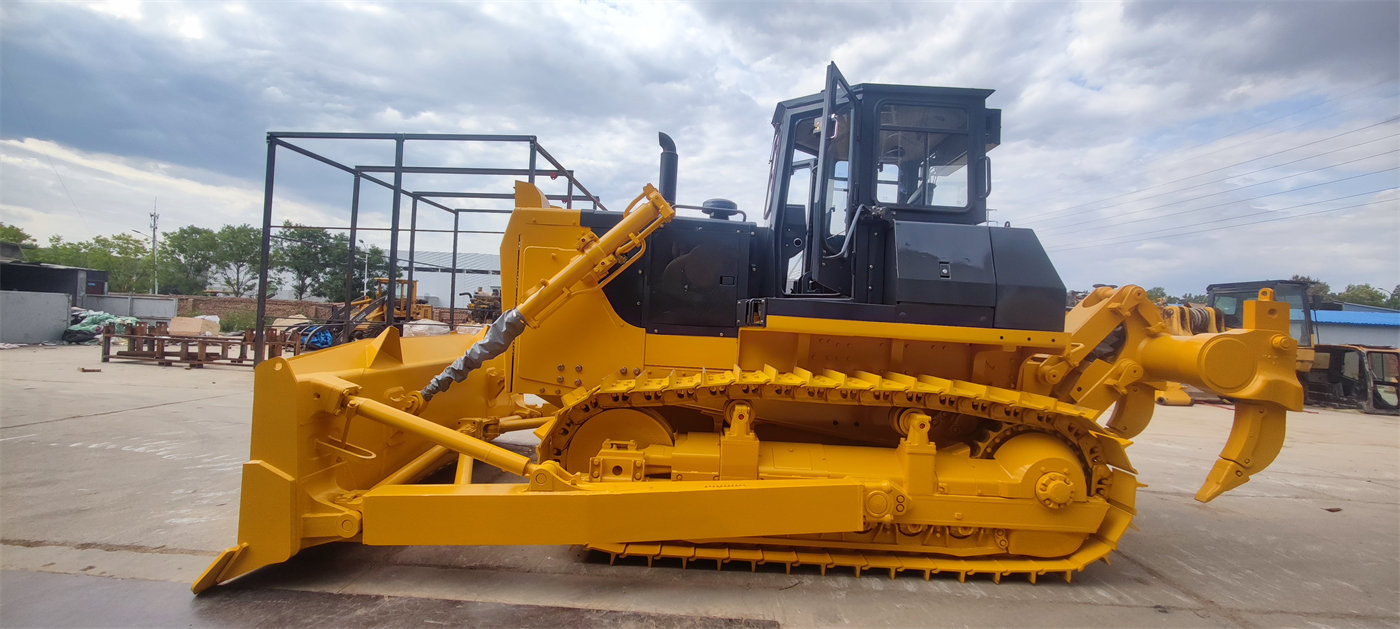
According to information on this site, the rated power of this platform is 257–258 kW (2000 rpm), with a WP12/QSNT-C345 engine, an electronically controlled engine meeting China Stage III emission standards. The standard and rock versions share this power foundation; differences concentrate on work equipment and the description of applicable scenarios.
| Comparison item | Standard version | Rock version |
|---|---|---|
| Machine positioning | Mining, ports, deserts, landfills, and various construction projects | Mining rock conditions, quarry extraction, weathered rock stripping, rocky soil excavation |
| Work equipment | Optional straight blade, semi-U blade, U-blade, angle blade, coal blade, rock blade, sanitation blade, ripper, drawbar | Rock straight blade, rock angle blade, rock semi-U blade; thickened high-wear-resistant rock blade edges, reinforced push arm assembly |
| Blade width (mm) | 4130 / 5000 / 4130 | 4130 / 5000 / 4130 |
| Operating weight (kg) | 40200 (with single-shank ripper and ROPS) | 40900 (with single-shank ripper and ROPS) |
| Ground pressure (kPa) | 97.7 | 99.4 |
| Drawbar | Optional | None |
As the table shows, the blade width options are the same for both versions; the differences lie mainly in blade and push arm reinforcement, operating weight, ground pressure, and drawbar. The rock version weighs about 700 kg more, with a corresponding increase in ground pressure; for the drawbar, the rock version is listed as none, while the standard version is optional. These two points directly relate to towing operations and trafficability on wet, soft ground and must not be overlooked during selection.
Which operational needs do work equipment reinforcements address?
The rock version information explicitly mentions thickened high-wear-resistant rock blade edges and a reinforced push arm assembly. For materials such as quarry extraction and weathered rock stripping, the blade experiences greater abrasion and impact than in ordinary earthmoving, so wear resistance and structural strength of the work equipment are priorities. The standard version lists a rock blade as optional work equipment, indicating that the standard version is not incapable of handling rocky material; rather, its default positioning is more toward multi-scenario versatility.
Two concepts must be distinguished here: the standard version optionally equipped with a rock blade is not the same as the rock version being customized as a whole machine for rock conditions. The former is a choice at the work equipment level, while the latter also involves structural reinforcement such as the push arm assembly. If procurement only checks the blade model, differences in push arms and overall machine configuration may be missed.
Commonalities in undercarriage, drivetrain, and continuous operation
Both versions share a mature high-strength undercarriage system, with a track ground length of 3150 mm, track gauge of 2140 mm, ground clearance of 500 mm, optional track shoe widths of 560 / 610 / 660 / 710 mm, and 41 track shoes per side. The drivetrain is a power transmission assembly matched to the engine power curve, with three forward and three reverse gears and a maximum forward speed of 11.5 km/h. Fuel tank capacity is 640 L, and hydraulic tank capacity is 97 L.
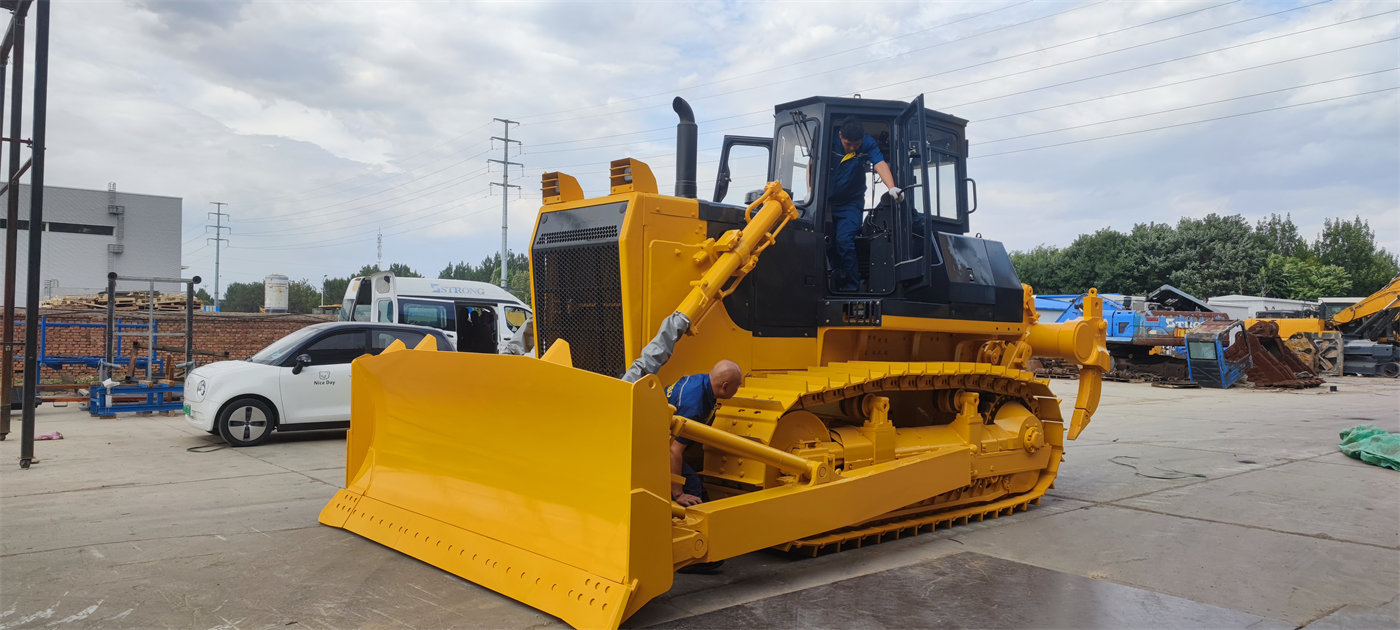
These commonalities mean that at the undercarriage load-bearing and drivetrain levels, the differences between the two versions are not as pronounced as in work equipment. What truly determines the configuration direction is still the degree of material wear on the work equipment and the requirements for operational continuity. In continuous operation, the undercarriage and drivetrain are the foundation, while the work equipment is the part in direct contact with the material; both must be considered together.
Impact of cab and maintenance configuration on heavy-duty operation
This platform adopts a six-sided enclosed cab, with optional FOPS&ROPS safety protection structure, equipped with electronic hand-foot integrated throttle and intelligent digital display control panel. For maintenance, wiring harnesses are protected by corrugated tubes and routed in tiers, large open side panels reserve inspection space, and lubrication and maintenance points are centrally arranged externally.
For heavy-duty dozing, the value of these configurations lies in the convenience of daily inspection and troubleshooting. Vibration and dust are more pronounced in rock conditions, and inspection frequency may be higher than in general earthmoving; open side panels and centralized maintenance points can reduce the disassembly workload during inspections. However, specific inspection intervals and items should still refer to the accompanying manual and must not be set based on experience alone.
Conditions under which the rock version is more worth considering
- The material is mainly weathered rock, crushed stone, or rocky soil, with blade abrasion and impact being the main sources of consumption;
- The work face requires frequent dozing of hard materials, and structural strength of the work equipment takes priority over versatility;
- The project does not use towing as a main auxiliary operation and can accept the rock version without a drawbar;
- Site bearing conditions allow ground pressure to reach 99.4 kPa.
Conversely, if the project is mainly general earthmoving and loose material pushing, with only occasional contact with rocky material, the standard version with optional work equipment may be more flexible; when towing operations are needed, the standard version's optional drawbar is also a practical difference. This does not mean the standard version cannot be used in rock conditions; rather, the configuration direction should follow the primary material.
Items to confirm before purchase
The information can explain configuration differences but cannot replace on-site verification. The following items should be clarified before inquiry and site entry:
- Material composition and proportions: proportion of rocky material, lump size range, and whether a ripper is needed;
- Workload and shifts: continuous operation duration determines the focus of undercarriage and cooling system verification;
- Site bearing capacity: the difference between 97.7 kPa and 99.4 kPa ground pressure needs assessment on soft ground;
- Transport conditions: overall dimensions are 8650 × 4130 × 3760 mm; transport routes and loading/unloading plans must be confirmed in advance;
- Final work equipment configuration: blade type, whether a ripper is included, and whether the drawbar is retained;
- Spare parts and maintenance arrangements: supply and replacement arrangements for blades and push arms under rock conditions.
The above parameters come from public information on this power platform; actual delivery configuration is subject to the contract and factory list. Optional configurations for different versions do not mean that a single machine has all configurations simultaneously; during inquiry, confirm each item according to the project's actual needs.
Conditions to provide when requesting a quotation
For heavy-duty dozing equipment inquiries, it is recommended to provide material type and proportions, average daily workload, site bearing capacity and slope conditions, transport dimension restrictions, operating hours per shift, and configuration requirements for blades and rippers. Equipment such as road rollers and landfill compactors belongs to other categories and is outside the scope of this article. Comparing the differences between standard and rock versions based on these conditions makes it easier to determine the configuration direction than looking at power figures alone.