













It is common for earthwork contractors to have both rough site leveling and heavier earth-rock dozing on the same project. Site leveling requires the blade width to cover the area and leveling operations to be flexible; heavy dozing requires sufficient tractive force and an undercarriage that can withstand sustained impact. When one medium bulldozer is shared between these two types of work, the configuration trade-off is often not about choosing "larger" or "smaller," but first determining which type of work dominates, then deciding the priority of blade type, undercarriage structure, and transmission configuration.
The following uses verified information for a 260-hp class medium bulldozer as a reference to explain the judgment approach for such coexisting conditions. No specific project cases are involved; the scenarios described are condition analyses.
First, distinguish where each type of work gets stuck
The difficulty of site leveling usually lies not in the amount of material pushed per pass, but in repeated adjustment and finishing: after pushing, the blade must be able to level close to the ground, blade lift and tilt must keep up with the operating rhythm, and the operator should not tire easily during long periods of low-speed back-and-forth work. The difficulty of heavy dozing lies in traction and structural load-bearing: no slipping when cutting in at full load, the tracks and main frame must withstand repeated impact, and power must not falter under high-temperature full-load conditions.
The requirements of the two types of work on the same machine are not completely consistent. The wider the blade, the greater the coverage per pass, but the cutting force per unit width when cutting into hard material will be affected; the larger the track ground contact area, the more assured the tractive force, but mobility during transfer and in narrow areas will be limited. Therefore, the first step in configuration trade-offs is to clarify the proportion of the two types of work and the material conditions in the project, rather than first comparing horsepower figures.
Which type of work the blade type corresponds to more heavily
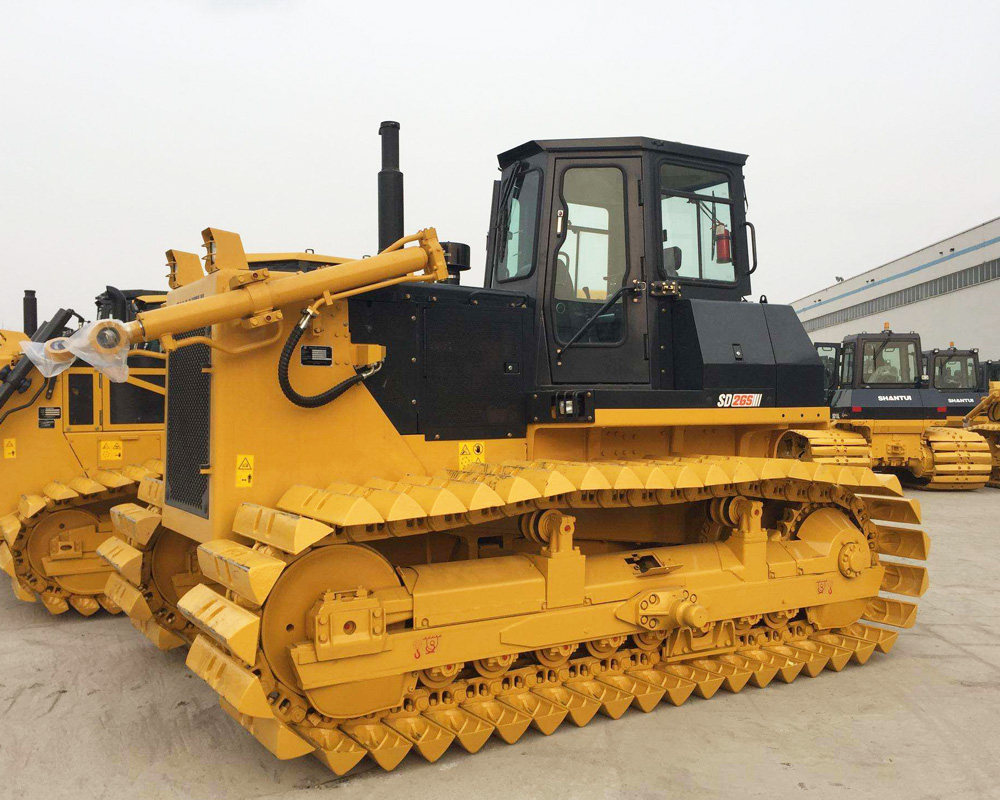
This 260-hp class medium bulldozer is equipped as standard with a straight-tilt blade, with a blade capacity of 4.6 m³, blade width of 3725 mm, height of 1315 mm, maximum lift height of 1210 mm, and maximum digging depth of 540 mm. The information also states that angle blades, U-blades, and semi-U blades are optional.
The straight-tilt blade is suitable for work focused on cutting and pushing, with cutting force as its design priority; if site leveling accounts for a high proportion and material needs to be moved to one side, the turning capability of the angle blade deserves more attention; the U-blade is more suitable for long-distance pushing of loose materials. In other words, the blade is not better the more complete the range, but rather one should first look at whether "pushing" or "leveling" is more frequent in the project, then decide whether the standard straight-tilt blade is sufficient and whether other types need to be selected.
- Mainly heavy cutting and short-distance pushing: prioritize verifying the cutting capability of the straight-tilt blade and the wear-resistant material of the blade.
- Mainly rough site leveling and lateral transfer: verify whether an angle blade can be fitted and whether the operating mechanism is convenient for frequent adjustment.
- Mainly long-distance pushing of loose materials: the applicable conditions of U-blades or semi-U blades need to be verified separately; this article's information only states they are optional and does not provide corresponding operating parameters.
Undercarriage and transmission determine whether the heavy-duty half can remain stable
The continuity of heavy dozing depends to a large extent on the undercarriage and transmission. This model adopts a semi-rigid suspended undercarriage, described in the information as expanding track ground contact area and improving tractive force; ground contact length is 2872 mm, ground contact area is 28727 cm², ground pressure is 66 kPa, and track shoe width can be selected as 560 mm, 610 mm, or 660 mm. Operating weight is 23450 kg, and maximum theoretical tractive force is 460 kN.
In terms of transmission, this model is equipped with a power-shift gearbox, torque converter, and two-stage straight-tooth main reducer, with three forward and three reverse gears, at speeds of 3.8, 6.9, and 11.8 km/h respectively. For site leveling, the stable output of low gears and smooth shifting affect leveling quality; for heavy dozing, the buffering and power transmission efficiency of the torque converter when load suddenly increases are more critical. Both share the same transmission, which means that at purchase it is necessary to confirm whether the project's main pushing distance and material hardness fall within the normal operating range of this power-shift configuration.
| Check item | Verified information | Significance for coexisting conditions |
|---|---|---|
| Ground pressure | 66 kPa | Reflects the pressure level of the tracks on the ground; wet and soft sites need separate verification |
| Track shoe width | 560 / 610 / 660 mm | Different widths correspond to different ground conditions and need to be confirmed according to the site |
| Maximum theoretical tractive force | 460 kN | Reference value for heavy dozing capability; actual performance depends on material and ground |
| Speed gears | Three forward / three reverse, 3.8–11.8 km/h | Low gears correspond to leveling and cutting, high gears to transfer |
It should be noted that low ground pressure does not mean the machine can travel on any wet and soft ground. The information does not provide conclusions on the passage of this model on specific moisture content, soft foundation, or slopes; such conditions must be separately confirmed in combination with the site.
Relationship between power and continuous operation time
This model is equipped with a WP12G280E304 engine, displacement 11.596 L, rated speed 1900 r/min, gross power 206 kW (277 hp), net power 194 kW (260 hp), maximum torque 1250 N·m @ 1200–1300 r/min, emissions China-III. Fuel tank capacity is 450 L.
When site leveling and heavy dozing alternate, the engine remains at medium-to-high load for long periods, and the cooling system and structural reliability deserve more attention than peak power. The information mentions a professionally matched cooling system for full-load and high-temperature environments, and an integral box-type main frame using high-strength steel and heavy castings. These descriptions can serve as verification directions, but actual performance under specific temperatures, altitudes, or continuous operation durations cannot be inferred from them; before purchase, confirm with the supplier in light of the project's shift arrangements.
This model is fuel-powered. The intelligent electronic control system mentioned in the information refers to automatic fault detection and operation monitoring, which falls within the scope of electronic control and does not represent pure electric power; it should not be confused with an electric bulldozer during selection.
Conditions still to be confirmed under coexisting working conditions
In projects where site leveling and medium-duty heavy dozing coexist, the following items cannot be directly concluded from the information and require supplementation by the purchaser:
- Material type and hardness: clay, frozen soil, gravel, or loose earthwork place different requirements on the blade and ripper. The information mentions an optional three-shank ripper with a maximum ripping depth of 666 mm, but whether it is needed depends on the actual strata.
- Pushing distance: the information does not provide an economic pushing distance; whether long-distance pushing should still be done by bulldozer needs to be judged in combination with the construction method.
- Site bearing capacity and slope: wet, soft, and sloping conditions require separate verification of track shoe width and travel capability.
- Transport and transfer: overall length is 5462 mm (excluding drawbar); the transfer method needs to be arranged according to actual transport conditions.
- Shifts and refueling: whether the continuous operation time corresponding to the 450 L fuel tank matches the project shifts needs to be confirmed in combination with actual fuel consumption; the information does not provide fuel consumption data.
- Safety and protection configuration: whether to select a roll-over protection structure needs to be determined according to on-site management requirements.
Question list organized by category before purchase
If the project indeed includes both rough site leveling and heavier earth-rock dozing, the following information can be provided first when requesting a quotation from the supplier, so that the other party can judge whether this 260-hp class medium bulldozer needs adjustment of the blade, track shoes, or ripper configuration:
- The shift proportion occupied by each of the two types of work and the main material types;
- The scope of the site leveling area, leveling accuracy requirements, and leveling method;
- The single distance of heavy dozing, material lump size, and loading coordination method;
- Site ground conditions, including whether wet and soft and whether there are slope sections;
- Daily work shifts, continuous operation duration, and fuel supply arrangements;
- Transport access route and overall machine transfer method;
- Whether blade type, track shoe width, and ripper need to be selected.
The standard, forestry, wetland, desert, sanitation, and rock versions of this model are different versions, and their configurations are not the same. The blade, undercarriage, and transmission information discussed in this article corresponds to the standard version description. If the project leans toward special scenarios such as wetland, rock, or sanitation, the specific configuration of that version should be verified separately, and standard version parameters should not be directly applied to other versions.