

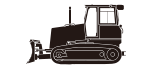
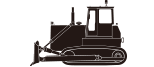
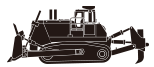









Small bulldozers are often asked, "Can it do this job?" The real question to ask first is, "What kind of machine can this site allow to enter and operate?" Only when the site is narrow, transport access is restricted, and the earthwork volume is modest but rough leveling is needed does a small tracked bulldozer come into consideration. Below, using the verified parameters of the SD10 on this site as a reference, the applicable conditions and the boundaries requiring separate confirmation are explained separately.
First Look at the Site: Width, Turning and Operating Space
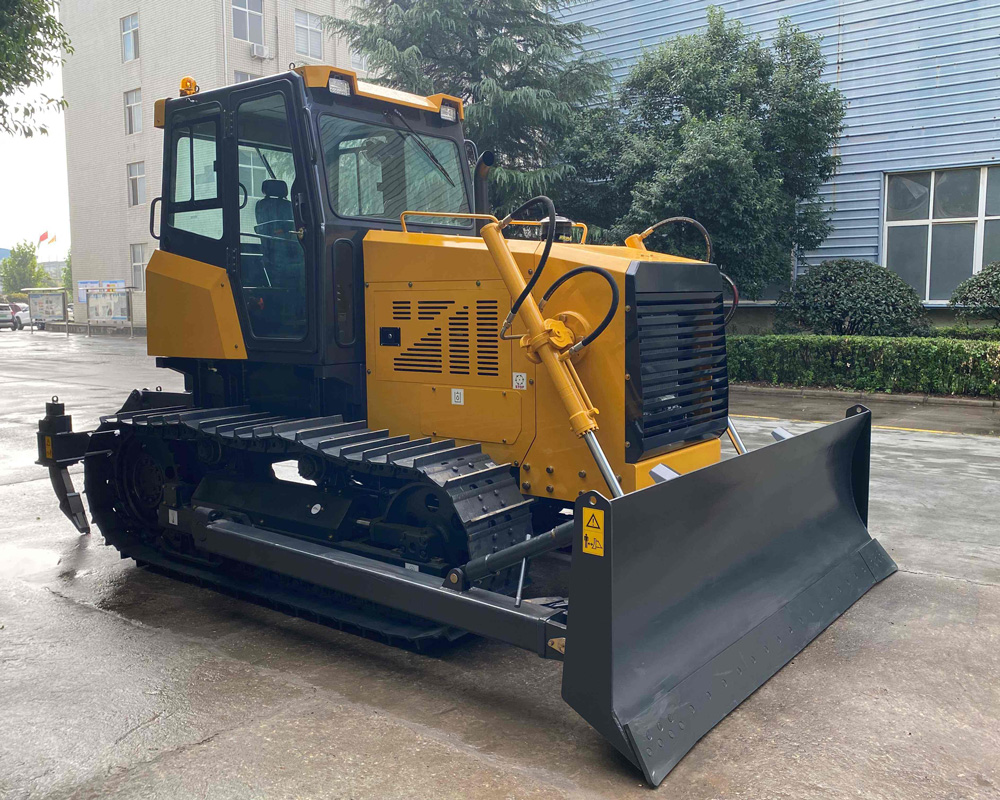
The value of a small bulldozer is first reflected in its dimensions. The SD10 has overall dimensions of 4400×2960×3030 mm, and its body is relatively compact, making it suitable for organizing pushing and rough leveling within building red lines, along municipal roads, or in plant areas where space is limited. This does not mean it can enter any narrow area, but rather that for the same pushing task, the overall machine outline takes up less space on access routes and work surfaces.
Note, however: overall dimensions are only static data. Whether it can actually operate also depends on blade width, the space required for slewing or turning around, and the impact of tracked travel on completed structures, pipelines and temporary roads. When there is a slope or foundation pit on one side of the site, safety distances should also be checked separately rather than judging only by body width.
Next Look at Materials and Tractive Requirements
The SD10 has a total weight of 10000 kg, a maximum tractive force of 95 kN, and is equipped with a Cummins 4BT3.9-C125 diesel engine with rated power of 81 kW (125 HP)/2300 r/min. These data indicate that it is positioned within the tractive capacity range of small tracked bulldozers and is suitable for tasks such as earthwork pushing, site leveling and material handling. However, whether the material is loose soil, backfill soil or compacted hard soil will significantly change the actual pushing resistance, and construction pace cannot be judged solely by the tractive force figure.
The blade dimensions are 2960×960 mm, with a maximum lift height of 830 mm and a maximum digging depth of 350 mm, and straight, curved or coal blades are optional. For rough leveling and short-distance pushing, these correspond to basic operating capability; if the material requires ripping or towing, a fixed towing device or three-shank ripper can be optionally fitted at the rear, but attachment configuration must be separately confirmed at the time of purchase and is not a default extension of standard configuration.
Ground Bearing and Ground Pressure
The SD10 has a track shoe width of 450 mm and a ground pressure of 54.4 kPa. This figure is a useful reference for judging whether operation on soft ground is possible, but it cannot be directly equated with "usable on wetlands." Soft-ground operation also depends on moisture state, surface vegetation, bearing capacity of lower layers and operating method. If the site has long-term standing water or is muddy, priority should be given to checking whether a wetland-type configuration is available rather than inferring from standard-type parameters.
In building construction, farmland improvement and site leveling, the 54.4 kPa ground pressure can serve as one basis for comparison with on-site soil conditions; whether it is ultimately suitable requires providing the soil description, weather and operating season together, with the supplier confirming in combination with the configuration.
Transmission and Transfer Conditions
The SD10 adopts a 4F+2R mechanical gearbox, with forward speeds of 2.6–10.4 km/h and reverse speeds of 3.7–6.7 km/h. This speed range is suitable for short-distance pushing within the site and movement between work processes. If the project requires frequent transfers across areas, transport dimensions, loading method and road width limits must be checked separately; the body dimensions of 4400×2960×3030 mm are only one item in transport verification and do not constitute a transport plan in themselves.
Applicable Boundaries and Items to Confirm
- Earthwork volume: Small bulldozers are more suitable for small and medium earthwork and leveling tasks; continuous pushing for large cut-and-fill work should not be evaluated under the same positioning, and the number of machines and shifts must be calculated according to the actual workload.
- Material hardness: Hard compacted soil, gravel-containing materials or materials requiring pre-ripping should be stated in advance; whether a ripper is fitted must be separately confirmed.
- Slope and side slope: The data do not give slope operation capability; when slope pushing is involved, this should be verified with the supplier as a special condition.
- Wetland and soft ground: Standard-type parameters cannot replace verification of wetland-type configuration; soil type and moisture conditions should be clarified before soft-ground operation.
- Transport and entry: Transport vehicles, road width and height limits and loading/unloading sites must be checked; transportability cannot be judged solely by body dimensions.
- Environmental protection and emissions: The data mention emission standards for environmentally compliant operation, but the emission requirements of the specific project location must be separately checked and confirmed.
Conditions to Provide Before Purchase
If the site conditions are close to the applicable scope of the small bulldozer described above, it is recommended to state the following together when requesting a quotation: material type and state, estimated earthwork volume, pushing distance, site dimensions and access routes, ground bearing and moisture conditions, whether ripping or towing attachments are needed, work shift arrangements, and the emission and transport restrictions of the project location. Only then can the supplier judge whether the SD10's standard configuration is sufficient or whether the blade or rear attachments need to be adjusted.
Before these conditions are verified, a particular model should not be directly identified as "the most suitable." The choice of a small bulldozer is always the result of joint constraints from site, materials, transport and configuration.