












When requesting quotes for earthwork excavation projects, the requirement is often written as "we need an excavator that digs fast, loads a lot, and can go down into the foundation pit." Passed to an equipment supplier, such a description usually yields only a tonnage range; comparing further reveals that machines with different configurations differ along more than one dimension. The problem is not that the requirement is too brief, but that it has not been broken down into equipment conditions that can be checked item by item.
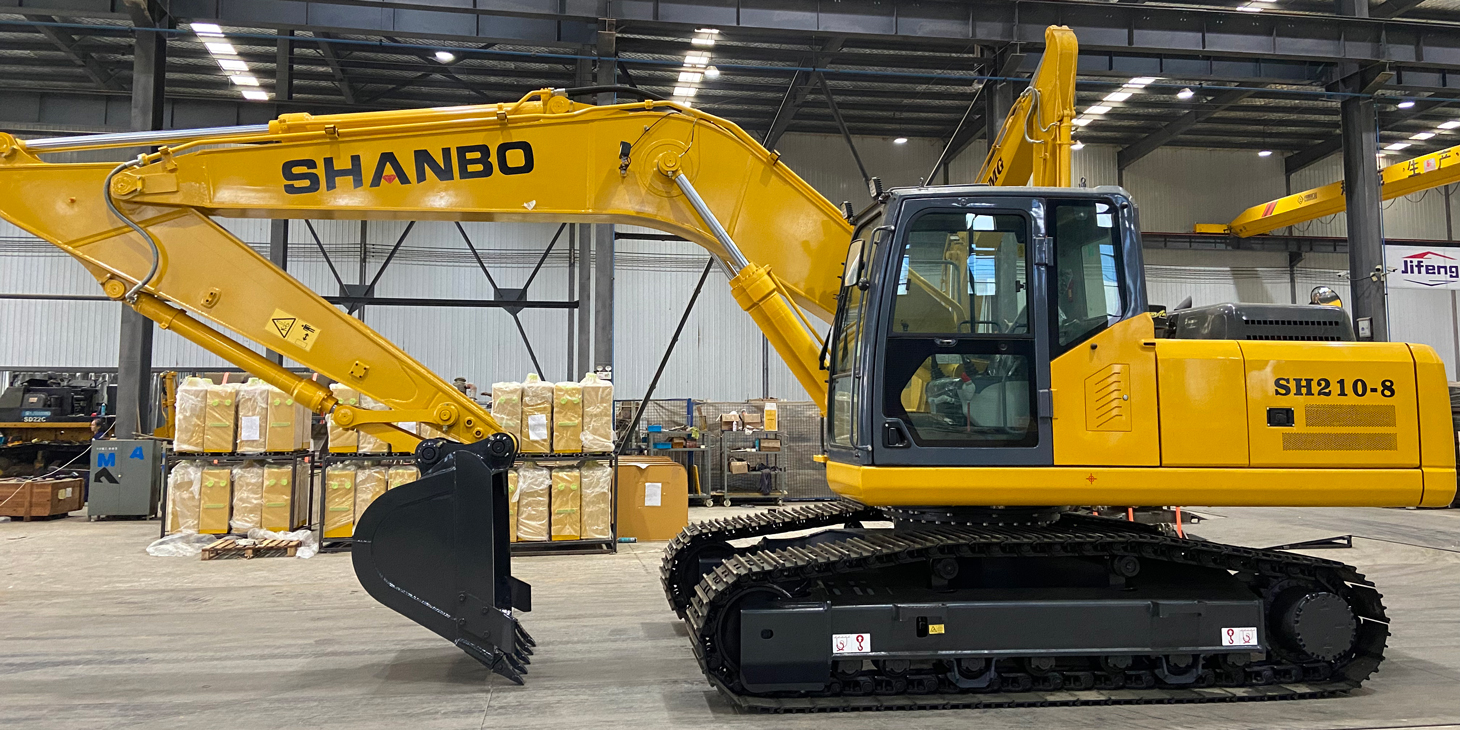
Breaking down the work objectives shifts the selection discussion from "which machine is better" back to "what actions must this machine perform, and what constraints apply." Below, using the latest data for the Shanbo SH210-8, a 21-ton crawler excavator, as a reference, we explain how a set of requirements maps onto verifiable items. First, a clarification: the SH210-8 figures are whole-machine specifications and do not mean it suits every earthwork condition; the specific project conditions mentioned in this article are examples, not actual customer cases.
First, distinguish the work objective: excavation, truck loading, or alternating between the two
For the same earthwork excavation, the equipment priorities differ.
- Primarily excavation depth: focus on maximum digging depth, maximum digging radius, and digging force; the machine must be able to remove soil within the given foundation pit or trench footprint.
- Primarily truck-loading coordination: focus on bucket capacity, whether the swing and dump height can connect with the transport truck bed, and the number of cycles per unit time.
- Alternating excavation and loading: both sets of conditions must be met, and transfer frequency and travel capability must also be considered.
SH210-8 data shows: 1.0m³ bucket, maximum digging depth 6350mm, maximum digging radius 9700mm, maximum digging height 10600mm, and digging force 126/134kN. These values help judge whether it falls near a project's working range, but they cannot replace verification of the specific excavation cross-section, transport truck height, and material condition.

Translating requirements into equipment conditions
1. Earthwork volume and shift determine bucket capacity and cycle rhythm
If the project is mainly conventional earthwork excavation and truck loading, a 1.0m³ bucket falls within the common configuration range for a 21-ton machine. Whether a larger bucket is needed depends on material bulk density and loading height; demanding a large bucket solely because "the volume is large" may exceed the matching range of the hydraulic system and whole-machine stability. The data does not give the correspondence for different bucket options, so this should be confirmed separately when requesting a quote.
2. Excavation cross-section determines depth and radius
Maximum digging depth of 6350mm and maximum digging radius of 9700mm can be used to preliminarily judge whether the machine can cover the pit bottom and the dump point. In actual operation, the machine's parking position, slope benching, and transport truck position all reduce the effective range. The values in the data are theoretical working ranges, not the actual reachable range at a given site. If the pit depth approaches or exceeds this value, the parking platform height and layered excavation plan should be recalculated.
3. Material properties determine whether digging force is sufficient
Digging force of 126/134kN corresponds to two engine configurations. Ordinary soil, loose backfill, and gravelly hard soil differ markedly in their digging force requirements. The data does not give applicability limits for different soil types, so one cannot conclude from the digging force value alone that "hard soil can definitely be dug." For hard interlayers, weathered rock, or material requiring breaking, a hydraulic breaker should be verified separately as a supporting solution rather than assuming the host machine can handle it alone.

4. Travel and transfer determine mobility requirements
The data gives travel speed of 28–35km/h and gradeability ≥70%. These figures can be used to assess short-distance movement within the site and the ability to go up and down ramps. However, crawler excavators still generally require flatbed transport for long-distance transfers; transport dimensions and weight are not fully provided in the data and should be confirmed before quoting.
5. Ground bearing capacity and ground pressure
A 21-ton crawler excavator has requirements for bearing capacity on soft ground, backfill areas, and rainy-season sites. This data does not provide a ground pressure value, so its passability on wetlands or soft ground cannot be judged. If the project is on soft foundations, riverbanks, or recently backfilled areas, ground treatment, mat laying, or switching to a model with lower ground pressure should be listed as items to confirm, rather than drawing conclusions directly from tonnage.
Parts of the SH210-8 data usable as a basis for preliminary screening
| Requirement item | Corresponding information in the data | What it indicates |
|---|---|---|
| Tonnage class | 21-ton crawler excavator | Falls in the mid-to-large excavator category and can be included in the comparison range for conventional earthwork and infrastructure construction |
| Bucket capacity | 1.0m³ | Used to judge the match between loading cycles and material bulk density; hourly output cannot be inferred directly |
| Engine power | 129/153kW, WP4.6NG175/6BTAA5.9 | Two configurations available; the specific choice must be combined with material and work intensity |
| Hydraulic system | 34.3MPa, 2×231.7L/min | Dual-pump high-pressure system, usable as a verification item when matching attachments |
| Digging force | 126/134kN | Corresponds to two engine configurations and must be judged together with material properties |
| Working range | Maximum digging depth 6350mm, maximum digging radius 9700mm, maximum digging height 10600mm | Used for preliminary screening of whether the pit and dump point fall within the coverage range |
| Travel capability | Travel speed 28–35km/h, gradeability ≥70% | Used to assess on-site transfer and ramp operation conditions |
As this table shows, the data is sufficient to support a judgment of "whether it enters the comparison range," but not sufficient to directly conclude that "a given project should choose this model." In particular, loading efficiency, soil adaptability, and soft-ground passability all require supplementary site conditions.
Cases requiring re-verification or separate consideration
- Excavation depth approaching or exceeding 6.35m: layered excavation, parking platform height, and slope stability should be calculated; single-layer operation cannot be arranged directly at the maximum depth.
- Material requires breaking: the host machine's digging force cannot replace a breaker. If rock or reinforced concrete is involved, verify the hydraulic breaker supporting solution for operating weight, hydraulic flow and pressure, connection dimensions, and piping; do not promise compatibility when data is insufficient.
- Site is soft foundation or rainy-season backfill area: ground pressure data is missing, so foundation bearing capacity should be confirmed first or matting measures taken.
- Frequent long-distance transfers: crawler travel speed does not equal highway transfer capability; transport method and dimensions/weight must be confirmed separately.
- Special loading height or transport truck bed: maximum digging height of 10600mm is a whole-machine specification; actual dump height is affected by parking position and bucket attitude and should be verified against transport truck parameters.
Conditions to provide when requesting a quote
To enable the equipment supplier to give a verifiable configuration recommendation rather than just a tonnage, it is recommended to provide the following information when requesting a quote:
- Material type and condition: ordinary soil, gravelly soil, backfill, weathered rock, etc., and whether large stones are present.
- Work objective: excavation depth, excavation width, whether truck loading is needed, and transport truck bed height and payload.
- Site conditions: ground type, bearing condition, slope, working face width, and whether frequent transfers are needed.
- Work volume and shifts: planned daily excavation volume, daily operating hours, and project duration.
- Supporting attachments: whether a hydraulic breaker is needed, and whether data on host hydraulic flow and pressure and connection dimensions is already available.
- Other constraints: emission requirements, transport method, and on-site power supply conditions (if electric equipment comparison is involved).
The SH210-8 data can serve as a reference for preliminary screening of 21-ton crawler excavators: 1.0m³ bucket capacity, 126/134kN digging force, 6350mm maximum digging depth, and 9700mm maximum digging radius cover the common verification items in conventional earthwork and infrastructure construction. But whether it suits a specific project still depends on conditions such as material, site, truck-loading coordination, and attachment matching. Clarify these conditions first, then discuss the model—only then does the selection discussion have a comparable basis.